Delivery Intelligence: A New Paradigm for How Work Gets Done
Why alignment, transparency, and leadership matter more—not less—in the age of AI agents
The Nature of Work Is Changing
Everyone Must Lead Now
For most of organizational history, leadership was concentrated. A relatively small number of people were responsible for strategy, alignment, and direction. Everyone else was responsible for executing their piece of the plan. That division of responsibility made sense when the work was slow enough, and the organization small enough, that coordination could happen through hierarchy.
Neither condition holds anymore.
When work is goal-oriented rather than task-oriented—when people are accountable for outcomes rather than just activities—the leadership skills that were once reserved for managers become universal requirements. Every person working in an AI-augmented environment needs to communicate with clarity, detect problems early, align their work to organizational strategy, and collaborate effectively across functions and boundaries.
This is not an aspiration. It is a structural necessity. And it is why Throughline combines its agent-based platform with guided support and integrated leadership training. We are not just delivering a tool. We are delivering a way of working.
A Network, Not a Hierarchy
Traditional strategy execution relies on a cascade: goals flow down through levels of management, get translated into departmental objectives, and eventually become individual tasks. The problem is that cascade is lossy. By the time organizational strategy reaches the person doing the work, it has been abstracted, filtered, and often distorted. People do their tasks without knowing—or being able to see—how those tasks connect to what the organization is trying to achieve. Also, in today’s environment, a lot of work – for some companies most work – is done by teams of people from different parts of an organization.
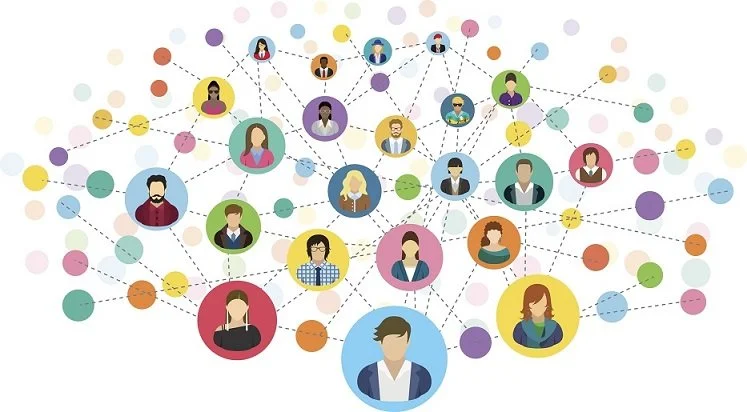
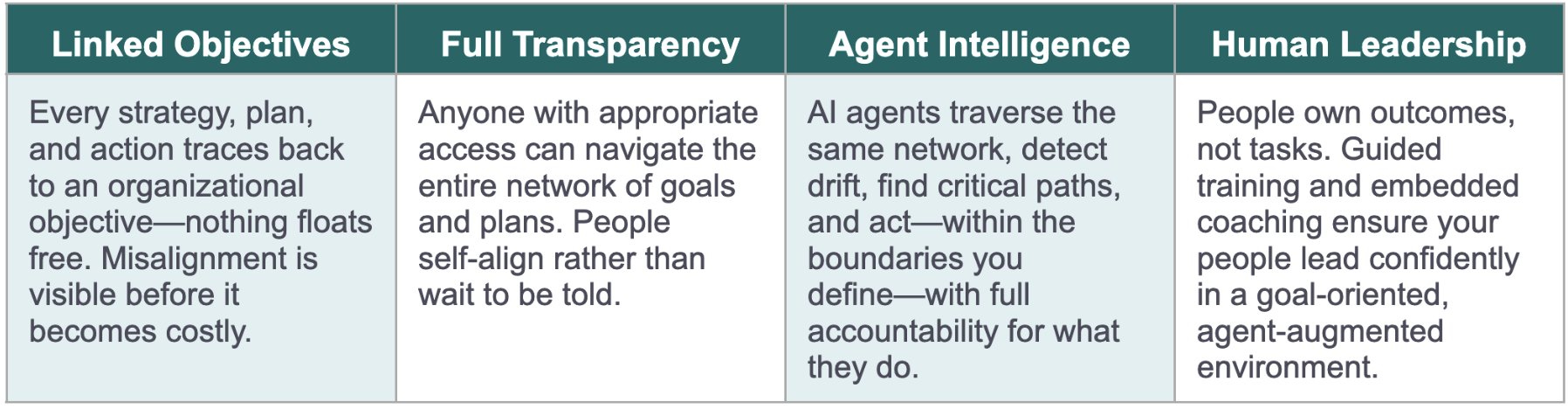
Delivery Intelligence replaces the cascade with a network. Objectives, strategies, execution plans, and actions are explicitly linked and fully navigable. Anyone with appropriate access can follow the thread from any action all the way back to the organizational strategy it serves—and forward to the outcomes it is intended to produce. That visibility is not just informational. It is operational. It enables people to make better decisions, raise better questions, and catch misalignment before it becomes failure.
Rapid Pivots Without Fragility
One of the most significant operational benefits of Delivery Intelligence is the ability to change direction quickly without breaking execution. Traditional project-based organizations are built around interlocking meshes of tasks. When circumstances change, every dependency has to be renegotiated. Change is slow, expensive, and demoralizing.
In a Delivery Intelligence environment, people hold goals, not task assignments. When priorities shift, they adapt their approach—and thoughtfully, responsibly redirect their agents. The network of linked objectives makes it possible to see, in real time, what the downstream effects of any change will be. Pivots become decisions rather than disruptions.
Something fundamental is shifting in how work gets done. Across industries and functions, people are beginning to rely on AI-based agents to handle an expanding share of the detailed, technical, and analytical work that once consumed most of a professional’s time. Jobs are evolving from doing to directing—from executing tasks to shaping outcomes, managing agents, and making judgment calls that machines cannot make.
The team of implementers is giving way to the team of designers. Technical collaboration at the task level—the back-and-forth of coordinating individual pieces of work—is being absorbed by agents. What remains and what grows more important, is the higher-order collaboration: setting direction, building alignment, making decisions, and leading across boundaries. This is not a distant future. It is happening now. And it is raising the stakes of something organizations have long struggled with.
When the pace of work accelerates, misalignment becomes more dangerous, not less. When every individual action can be magnified by the speed and reach of an AI agent, the cost of acting on the wrong assumptions multiplies accordingly. More capability without better alignment doesn’t solve the alignment problem—it amplifies it.
The old warning applies with new urgency: “a fool with a tool is still a fool.” Powerful tools in the hands of unprepared people create powerful disasters. Throughline was built to ensure that doesn’t happen
Delivery Intelligence: What It Is and How It Works
Delivery Intelligence is the operating model at the heart of Throughline. It is built on a simple but powerful premise: when objectives, strategies, plans, and actions are all linked—and fully visible—people and agents can self-align, self-correct, and act with confidence. The result is an organization that moves faster, makes better decisions, and recovers from disruption more quickly than one held together by meetings, status reports, and org-chart authority.
What Agents Do in a Delivery Intelligence Environment
AI agents in Throughline are not autonomous actors operating outside the organization’s intent. They are participants in the same network of linked objectives that guides every human decision. They can traverse the network, understand context, and act intelligently—within boundaries that the organization defines and controls.
Specifically, Throughline’s agents:
Spot problems. Detect misalignment between actions and objectives, surfacing drift before it compounds
Find critical paths. Identify critical paths and bottlenecks across the full execution network
Execute. Complete agent-doable work—software development, analysis, planning, documentation—when given permission to do so
Reason and advise. Answer “what if?” questions with informed responses, often coordinating with other agents to synthesize a complete picture
Collaborate openly. Collaborate with each other and with people, as transparent and accountable partners in execution
Agents do not replace human judgment. They extend it—making it faster, better-informed, and more consistently aligned with what the organization actually cares about.
Specific Outcomes and Benefits
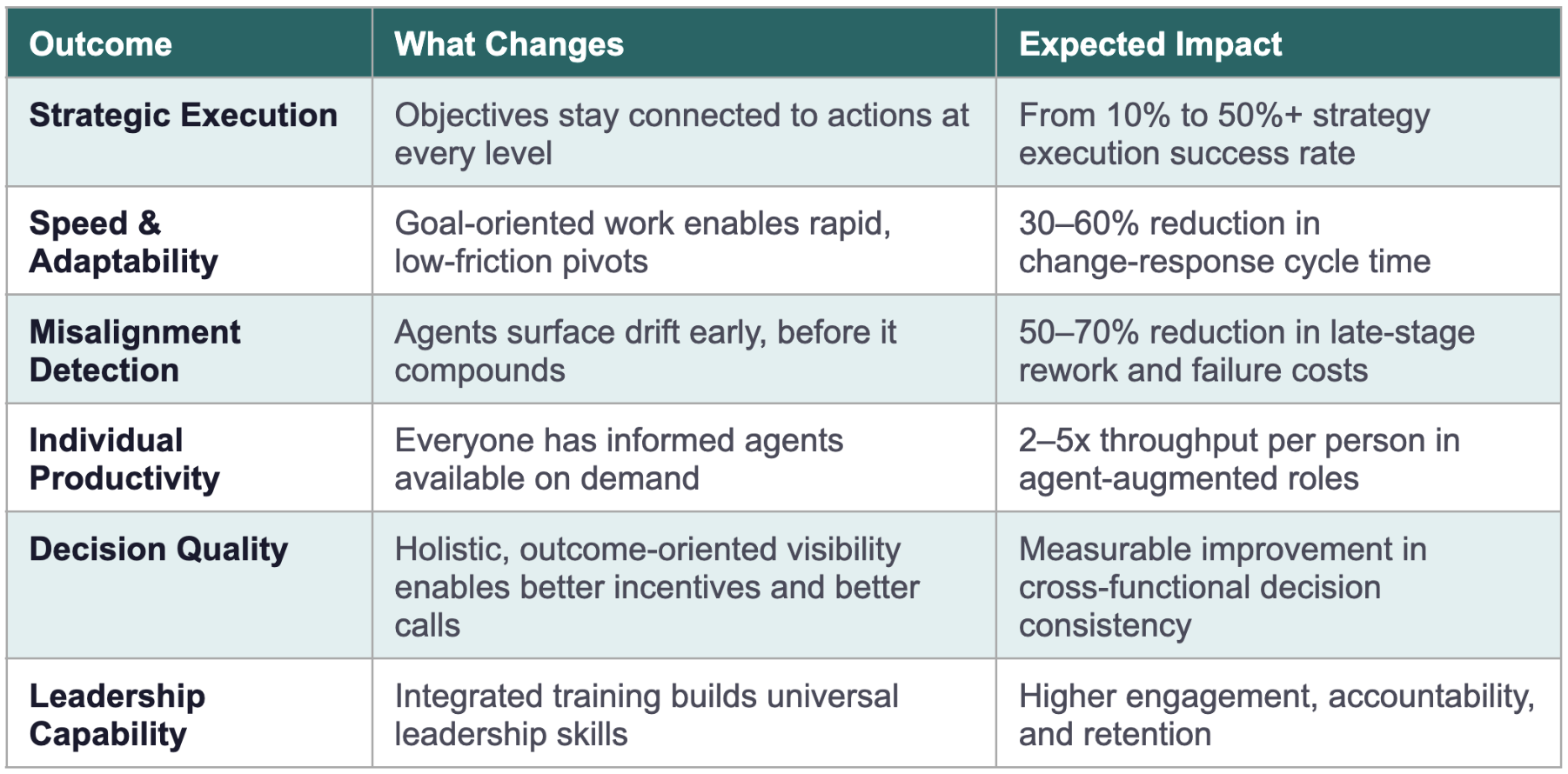
The following outcomes are grounded in documented results from Constructive Agility® engagements and the operational logic of Delivery Intelligence. Organizations that adopt this way of working consistently see measurable improvement across the dimensions that matter most.
These outcomes compound. An organization that executes strategy reliably, adapts quickly, catches problems early, and develops leadership at every level does not just perform better in any single quarter. It builds a structural advantage that widens over time. Constructive Agility® engagements have documented return on investment ranging from 2,969 to 11,421 percent, driven by precisely this dynamic.
A New Paradigm—One That Everyone Must Embrace
Delivery Intelligence is not an incremental improvement to how organizations work. It is a paradigm shift. And like all paradigm shifts, it requires more than technology. It requires a different way of thinking about work, about accountability, about the relationship between people and AI, and about what leadership means.
When everyone is responsible for outcomes rather than tasks, and when every person’s actions can be amplified by agents, the old distinctions between “strategy” and “execution,” between “leaders” and “implementers,” become less meaningful. What matters is whether everyone in the organization—at every level—understands where they are going, why it matters, and how their work connects to the whole.
That is what Delivery Intelligence makes possible. And that is why Throughline pairs its platform with the guided support and integrated leadership training to help your people not just adopt a new tool, but inhabit a new way of working.
The organizations that thrive in the next decade will not be the ones with the most AI. They will be the ones that combined AI capability with human alignment—where strategy, execution, transparency, and leadership are woven together into a single coherent operating model.
That is what Throughline is built for.