

AI Has Made Project Management Obsolete — Today You Need Strategy Execution Management
The whole concept of project management is obsolete
Project management dates from the traditional view of corporate finance, in which a company is in a “steady state”; the company plans a “project” that will take the company to the new state. The project is executed, and when complete, the company is in a new steady state until there is another project. Whatever was built by the project is in maintenance mode.
That’s not how things work anymore – at least not in the tech field. Things move too quickly. There is no steady state. Few tech projects are ever done – the only ones that truly complete are those that “lift and shift” something; but any project that creates or adds something new is never-ending, because by the time the project has finished, whatever was added has become somewhat obsolete, either because of updates to the product’s third party components, or because the industry has moved forward.
There is no maintenance mode: there is only forward motion – adding to the product.
There is no steady state.
That means that there is no completion point. There are surely milestones, such as “Add the capability of the product to do XYZ”, or “Complete release 4”, but while you are working on that, things might change enough that you need to reimagine XYZ or alter release 4 before you even finish it.
The market is now a moving target.
Even if the market is stable enough in the course of working toward a milestone, you cannot afford to get it wrong: if you deliver something that is off the mark from what people want, you not only lose reputation, but you lose time – and time matters a lot today, often more than anything else.
That’s why maintaining tight alignment is so crucial today. Contrary to the “Agile” idea that one can try something and then pivot, that approach is no longer a good strategy for releasing products. One must get it right. Any pivoting needs to happen early on with trial users, and rapidly, and early iteration is more and more feasible now using AI. The clock is ticking.
Alignment is key; and since things are always shifting, and since you are learning what is needed along the way, alignment must be maintained as things shift. During the time you are working on a release, a competitor can use AI to release several new features, changing what your release needs to do.
In other words, you don’t need project management: you need a strategy execution approach that continuously tracks outcomes and maintains alignment as strategies shift.
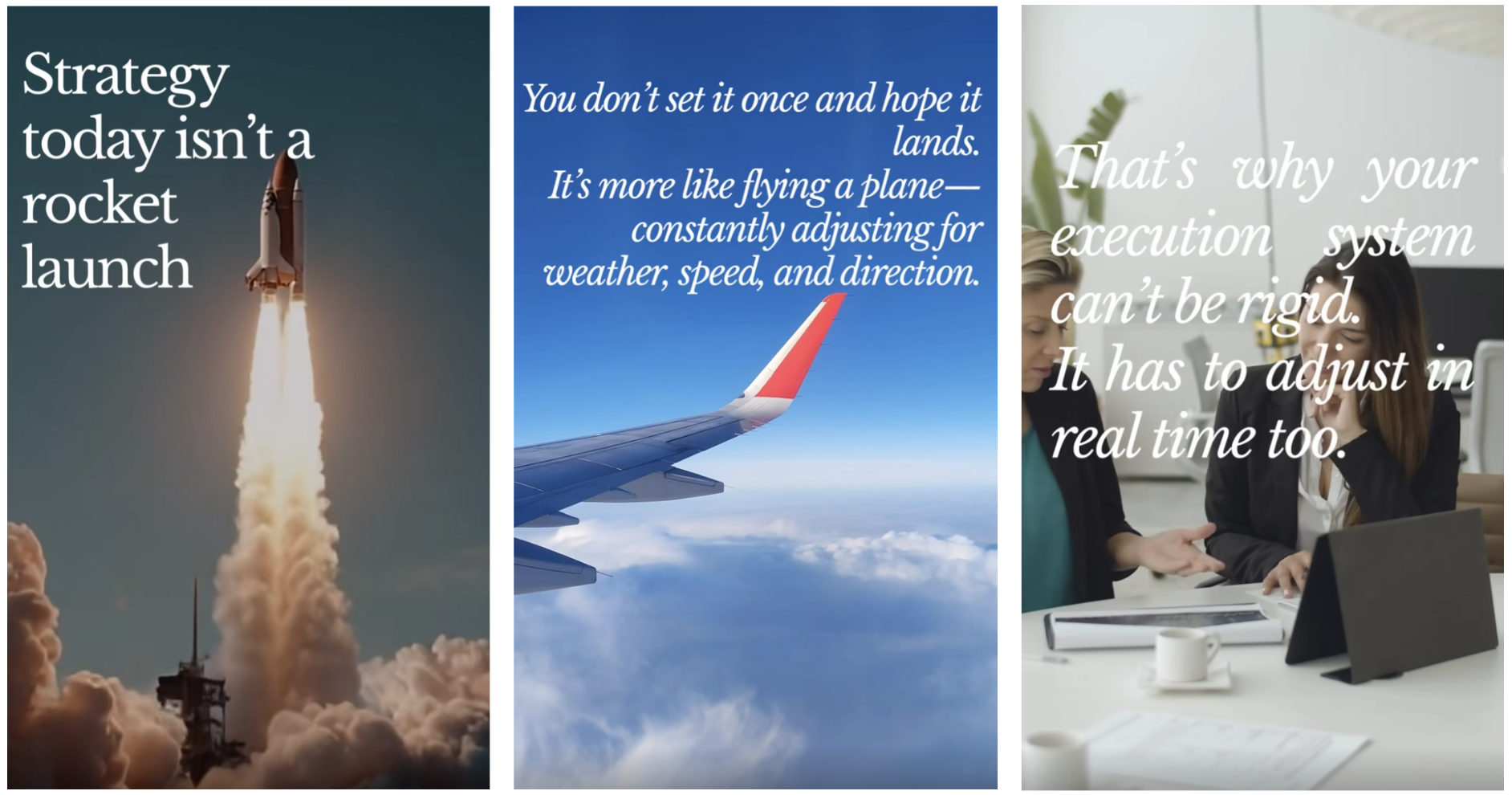
Instead of a point-and-shoot projectile, you need an outcome-seeking missile that tracks the target as the target moves.
Why the task-based approach is dead
Tasks are your idea of how to solve a problem – but they are what you thought at the start. As you progress, your understanding improves, and your approach shifts. Many tasks become irrelevant.
But if progress is assessed based on tasks, people will try to not alter the tasks: they will plod ahead, rather than thinking “Now that I understand this better, what should I really do?” – that would result in different tasks.
The existence of tasks focuses discussions on the task status:
“Is it done yet?”
“What percent done is it?”
For creative work, which includes any form of engineering or software creation, the question “What percent done is it?” is a nonsensical question. One cannot know – if one knew, the work would be done:
Engineering design and software design are the process of elaborating a high level design into a low level design: that is, defining all of the “leaves of the tree”. But you cannot know how many leaves there are until you have defined them all. And if you cannot count the leaves, then you don’t know how much work remains.
Also, engineering and programming are domains in which one never designs the same thing twice. Therefore, it is common that one encounters an unexpected roadblock. In programming this takes the form of,
“It should work, but it doesn’t, and I am not sure why”.
Programmers and engineers spend most of their time trying to figure out why their code or design doesn’t work. That’s the process: create some code or part of a design, try it, and then figure out why it doesn’t work.
If you are using AI to do the design or implementation, you still have to test it, and often it doesn’t work. Or you might discover that there are security vulnerabilities, or performance issues, or integration issues. The day when AI tools can literally do the whole job without any issues is the day that we all can go home – including managers. We are not there yet.
So asking “How done are you?” is a particularly frustrating question – they don’t know, but they feel compelled to provide an answer – and it is a BS answer.
An outcome-focused approach
Much better questions are ones like,
“Is your current approach working?”
“What is in your way?”
“Can you please explain the approach, so that we can talk it through?”
“What could we do to simplify this?”
“How could this be sped up? (e.g. by using AI)”
“What things could go wrong?”
These are about the situation – not about filling out a checklist. These open conversations, which can lead to understanding and then to solutions that move things forward.
And guess what? Team leads who do this don’t need to have meetings to find out where things really stand – they already know, because they have been talking to the people doing the work and had real conversations about issues rather than completion status.
Why end-to-end line-of-sight is essential for trust
We hear a lot about trusting the team, or trusting people in their work. But it is hard to trust people if you don’t really have visibility into what they are doing and how they are doing it.
Unless you are dealing with someone who has a truly stellar track record, visibility is essential for trust. If a manager is accountable for outcomes, then to be able to trust their people they need to be able to see what is really happening on the ground. They need that visibility; otherwise, they are relying on claims of what percent done things are – and we have all been in a situation when someone said something was 90% done, only to eventually find out that there is a severe problem and that it will actually never be done.
This applies at all levels. Senior managers need visibility into what other managers are doing, and how they are approaching it. Meetings are one way, but meetings are very inefficient, and if all of the managers in the meetings are relying on testimonials of how done things are, then it is like the blind leading the blind.
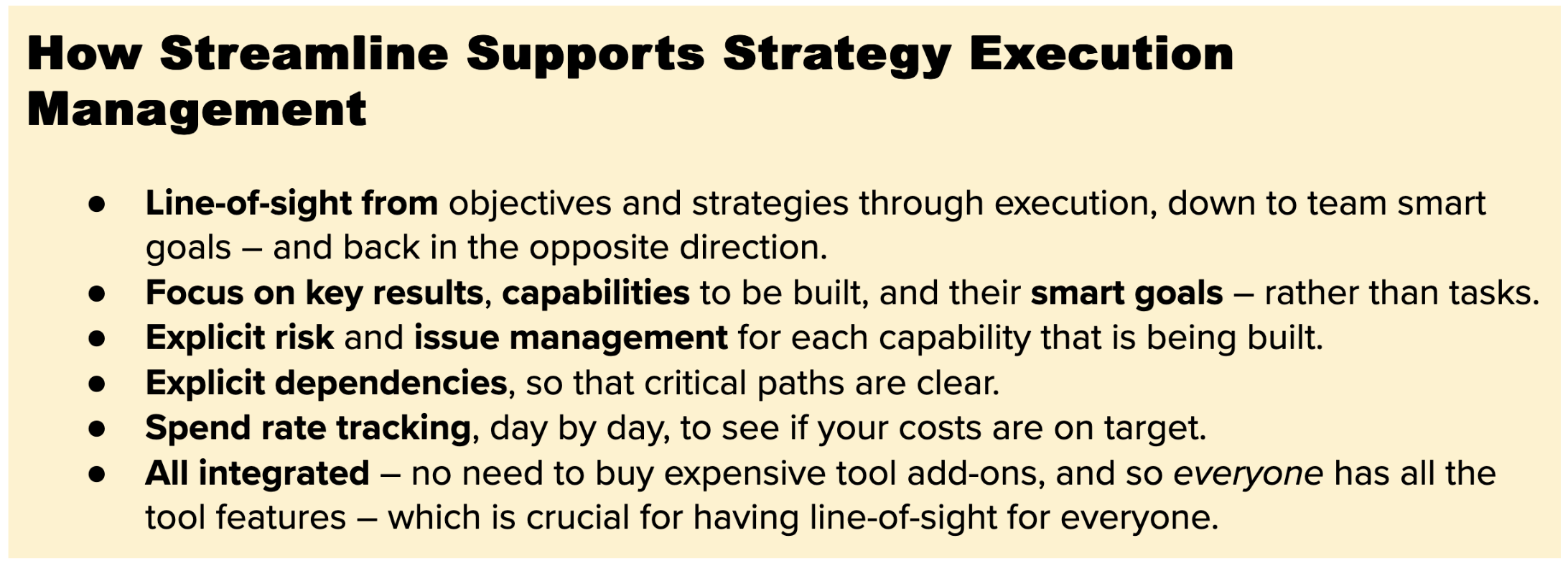
What is needed is true end-to-end visibility – “line of sight” from objectives through strategies and execution. One needs to be able to see how others are implementing a strategy, and how those expand into their project level goals. And tracing that path needs to be easy and quick – a few clicks; otherwise, no one will do it.
Individual contributors also need to be able to find out easily what strategy they are supporting – with one or two clicks. Knowing why one is doing something really helps them to make decisions on the ground, rather than always having to find their team lead or higher up and ask.
All this creates alignment, in real time. Meetings are not needed to maintain this alignment. Meetings can be for going deep:
“Is our strategy working?”
“Team 123 is implementing the strategy by creating two new capabilities – are those the right ones?”
“Team 456 has some smart goals that demonstrate that a new capability will work – but do those smart goals suffice to show that it really integrates with team 123’s new capabilities?”
Instead of checking timelines that are based on “How done is it”, one can drill into issues that will determine success.
Line-of-sight: that is what is essential. And if you have it, you can trust, because you can see what is really happening and not bother teams that are well aligned – you can focus on those that are not.
Instead of hoping that project completion statuses are honest, that all those green status bars are really truthful, and that nothing has changed since you created the task plan, you can manage the execution of your strategies.
That’s strategy execution management.
More information about Streamline can be found here.
