

“Beyond Budgeting” Provides Agile’s Missing Pieces
Beyond Budgeting is a breakthrough framework for leading organizations at scale in a way that maximizes value creation. It is about much more than budgeting – in fact, it is mostly about leadership – but one of the cornerstone ideas that enables the leadership approach is to keep separate three things that traditional business finance practices force together: one’s forecast, one’s target, and one’s allocation of resources.
This is a well tested approach: Beyond Budgeting was pioneered at Equinor (formerly Statoil), one of the world’s largest energy companies, as well as countless other global corporations. Some of them include IKEA, H&M, Bosch Siemens, Ericsson, Deutsche Telekom, ING, Barclays, Mærsk, Aviva, Telekom Malaysia, Petronas, and many, many others.
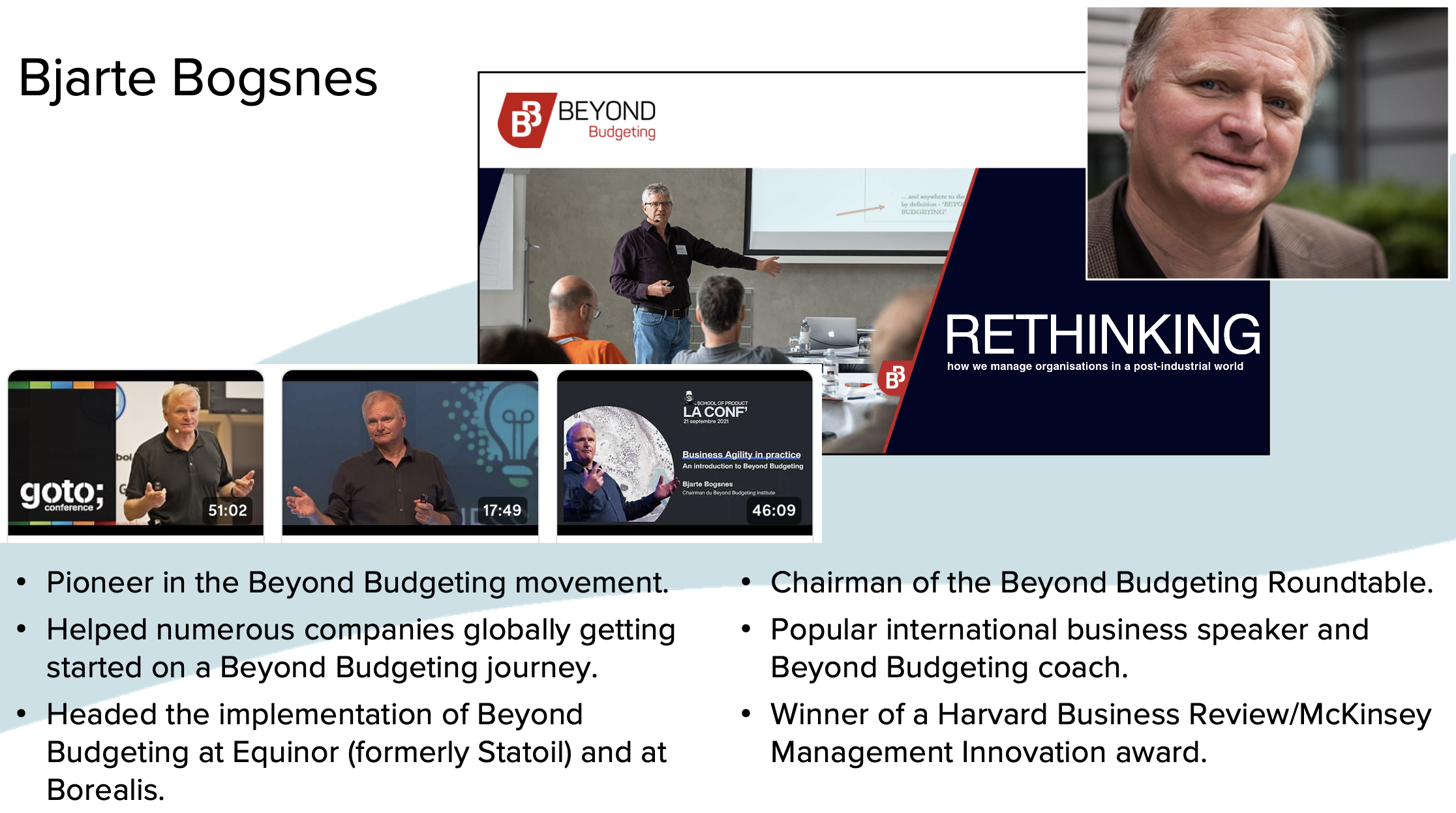
At Agile 2 Academy we realized that our leadership program strongly aligns with what Beyond Budgeting teaches. We therefore reached out to Beyond Budgeting’s chief advocate, Bjarte Bogsnes, who runs the international Beyond Budgeting Roundtable of business leaders.
Bjarte has actually been very interested in the Agile movement since the beginning. In fact, he gave a talk at the first international Agile conference. One of his friendly critiques of Agile, however, is that it is team-centric and does not address the corporate issues that enable, support, and actually generate true agility. He can explain at length how Beyond Budgeting fills those holes, and thereby makes Agile methods actually work at scale. It is therefore no surprise that there is a lot of overlap between Beyond Budgeting and Agile 2, as well as our leadership development program, which all focus on the organization instead of just the team level.
When we developed Streamline, Beyond Budgeting was much in mind. This is because we wanted Streamline to be a truly agile tool, in the sense of supporting true business agility and adaptability, at scale, for real organizations. Streamline is not about Agile frameworks: it is about things like managing spend rate instead of only budget, separating aspirational targets from commitments, and allocating resources continuously instead of locking them down to a budget. It is also about establishing line-of-sight to strategy for everyone, focusing on outcomes instead of tasks, and empowering people to plan their own work. There is no mention of Scrum or any Agile framework, although it can be used with those.
Here are clips from a recent discussion with Bjarte: https://vimeo.com/1151070636
Watch it: it is fascinating.
Some key takeaways:
Leadership is an essential component of adaptive management — of true agility — and everyone needs to be a leader.
Beyond Budgeting provides the things needed to make Agile ideas actually work at scale.
There must be congruence between what leaders say and what they do.
One must not merely “communicate downward” – one must challenge people to “translate” objectives and strategies for their situation.
Clear line-of-sight to strategies and objectives is essential – for everyone.
It is more effective to trust and observe than to govern by lots of constraining rules.
Forecasts are important, but they are often wrong, and so agility is even more important.
One must separate forecasts, targets, and allocations as separate and independent calculations.
Choice of vocabulary is important when communicating both upward and downward.
